
Air in the system steals heat: how the Flamco VacuStream vacuum degasser protects heat pumps and underfloor heating
The heat pump is installed and the underfloor heating is in place, yet rooms warm up slowly, some zones stay cool and the pump is noisy. The cause is often gas dissolved in the system water. This article explains where it comes from, what damage it does and how the compact Flamco VacuStream vacuum degasser removes it.
Where the gas comes from and why it matters
Every closed system is filled with water that contains dissolved air. Some of it escapes during venting, but a large amount stays in the water and is released gradually as micro-bubbles.
In high-temperature systems, conventional air separators do a good job. In low-temperature systems (heat pumps, underfloor and wall heating, cooling) gas separates less easily and ordinary separators lose effectiveness. Vacuum degassers solve the problem, but until now they were too large, expensive and noisy for a small home.
What gas in the system causes
Bubbles hinder heat transfer and even flow distribution.
Oxygen in the water attacks the metal parts of the boiler, heat pump and valves.
Biofilm develops in low-temperature systems, and sludge narrows pipes and heat exchangers.
Problems build up over time. Flushing helps only temporarily; prevention is cheaper and more reliable.
How VacuStream works
- VacuStream degasses the water on a fixed cycle. A piston inside the housing creates a vacuum in a small portion of system water, and the dissolved gas is released as bubbles.
- The bubbles rise to the top. When the piston returns to its starting position, the gas is discharged through the Flexvent automatic float air vent at the top of the unit.
- The cycle repeats automatically, and the system is gradually freed from dissolved gas. The unit has no set flow direction, which reduces installation errors.


Air separator or vacuum degasser?
Flamco shows the choice with a simple graph. The horizontal axis is the system pressure at the installation point (0.5 to 2 bar), the vertical axis the maximum system temperature.
At high temperatures and low pressure (red zone), conventional air separators work well. At low temperatures and higher pressure (blue zone) – typical for heat pumps and underfloor heating – vacuum degassers such as VacuStream are more effective.


Which systems it suits
- low-temperature systems up to 500 litres
- heat pumps, underfloor heating and cooling in homes and small commercial buildings
- operation from −5 °C to 65 °C, for both heating and cooling
- systems with glycol-based anti-freeze up to 50%
- new construction and renovation
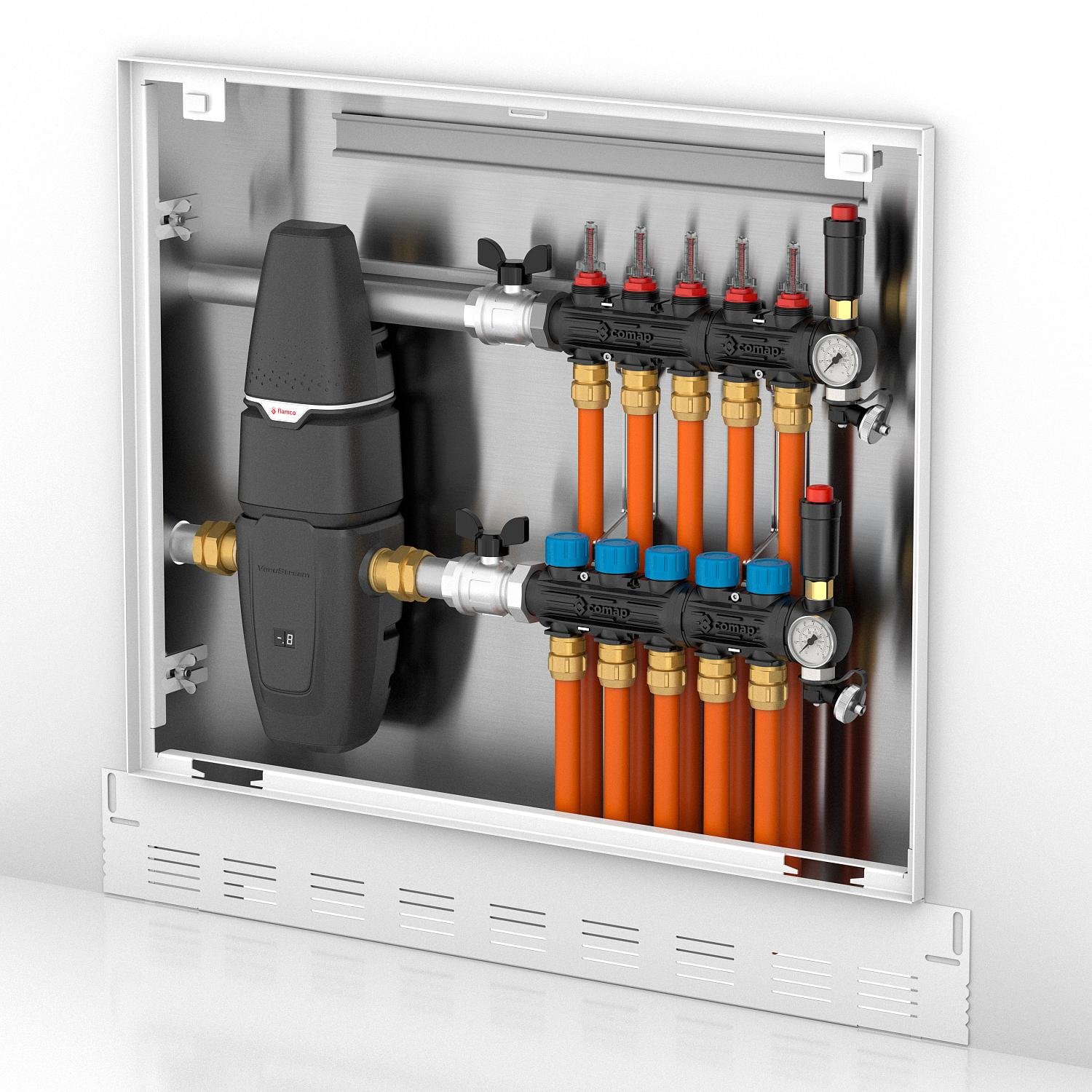
- installation in the underfloor heating manifold cabinet
Advantages
Technical data
| Article | 17050 |
|---|---|
| Max. system volume | 500 l |
| Working / peak pressure | 3 / 6 bar |
| Temperature range | −5 °C … 65 °C |
| Max. glycol content | 50% |
| Noise level | < 42 dB |
| Power supply | 12 V / 230 V |
| Energy consumption | 8.5 kWh/year |
| Control | 2-digit display |
| Connection | DN25, G 1" female (for DN20 with adapter DN20 × G 1" male) |
| Weight | 4 kg |
Pressure loss
The graph shows the pressure loss (kPa) depending on the flow rate (m³/h). At about 1.5 m³/h the loss is around 3 kPa.

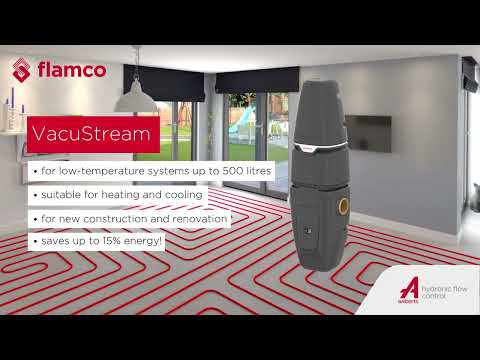
Flamco animation: how VacuStream works
See how it works
Buy from the official importer
Tech2010 is the official importer of Flamco products in Bulgaria. We will help you choose the right solution for your system and supply an original product with full documentation and warranty.
View VacuStream in the shop Datasheet (EN, PDF)Technical data: Flamco (Aalberts hydronic flow control).
Related Products
0 reviews